Every concrete project hits the same fork in the road. You can buy bags of premix and mix them yourself, or you can order ready-mix and have it delivered in a truck. Both work. The right choice comes down to how much concrete you need and how fast you can place it.
Start with the volume
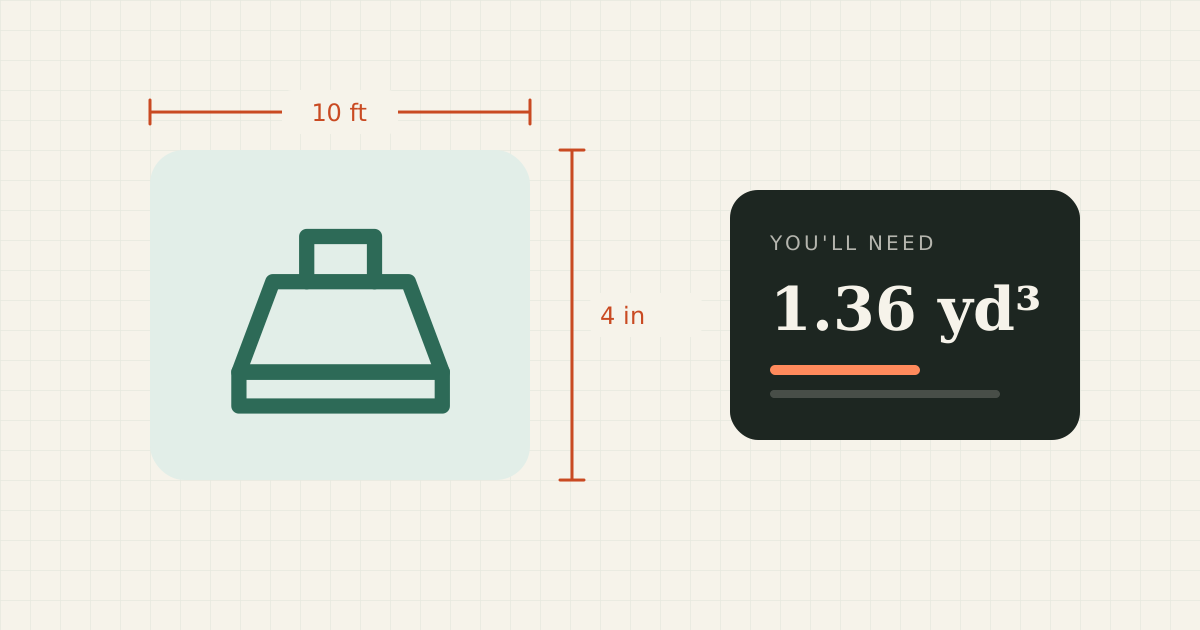
Before anything else, work out how many cubic yards the job needs. The concrete calculator will give you the number in cubic yards and in bags. A cubic yard is 27 cubic feet, which is about 45 bags of 80 lb mix.
That number does most of the deciding for you.
When bags make sense
- Post holes. Fence posts, mailbox posts and deck footings use a bag or two each. Bags are the obvious choice.
- Small pads. An AC pad, a landing at the bottom of steps, or a small shed base under about half a yard.
- Hard-to-reach spots. Backyards with no truck access, where every load would have to be wheeled in anyway.
- Work you can split up. Separate footings that don't need to be poured as one piece.
When ready-mix makes sense
- Anything over about a yard. Past 45 bags, hand mixing gets slow and tiring, and the batches start to vary.
- Slabs that need one continuous pour. A patio or driveway should be placed all at once. If the first section starts to set before the last is in, you get a cold joint, which is a weak line where cracks like to form.
- Consistent strength. A plant batches every load the same way. Hand-mixed concrete changes with every bucket of water.
The middle ground
For jobs between half a yard and about a yard and a half, there are two in-between options.
Rent a mixer. A towable or electric drum mixer turns bag concrete into a steady production line. With two or three people (one mixing, one hauling, one finishing), you can place a small patio in a morning.
Ask about short loads. Many ready-mix suppliers deliver less than a full truck for an extra fee. Some areas also have trailer services that tow a small batch to your house. Call around, since policies vary a lot by town.
Rule of thumb: under half a yard, use bags. Over a yard and a half, order a truck. In between, compare the cost of a mixer rental and your time against a short-load fee.
Don't forget the people
Concrete waits for no one. Whichever way you go, line up your help before the day. A truck pours fast, and you'll need people with rakes and a screed board ready the minute the chute swings over. With bags, you'll need someone mixing while someone else places and finishes.
Prep is the same either way
Whether it comes from a bag or a truck, concrete is only as good as what's under it. Dig out to the right depth, lay and compact a gravel base, and build solid forms before the first bag is opened. The gravel calculator will tell you how much base material to order.