How this paint calculator works
Paint is sold by coverage, so the number that matters is the square footage you plan to roll. We get it by adding up the four walls (the room's perimeter) and multiplying by the wall height.
Then the openings come out. A standard interior door is about 3 by 7 feet, so each one removes 21 square feet. A typical window is closer to 3 by 5, so each removes 15. If you have a big picture window or a sliding door, count it as two windows.
Last, the wall area is multiplied by your number of coats and divided by the coverage rate. Most interior cans say 350 to 400 square feet per gallon. We start at 350 because walls in real houses are never as smooth as the test panels used to write that label.
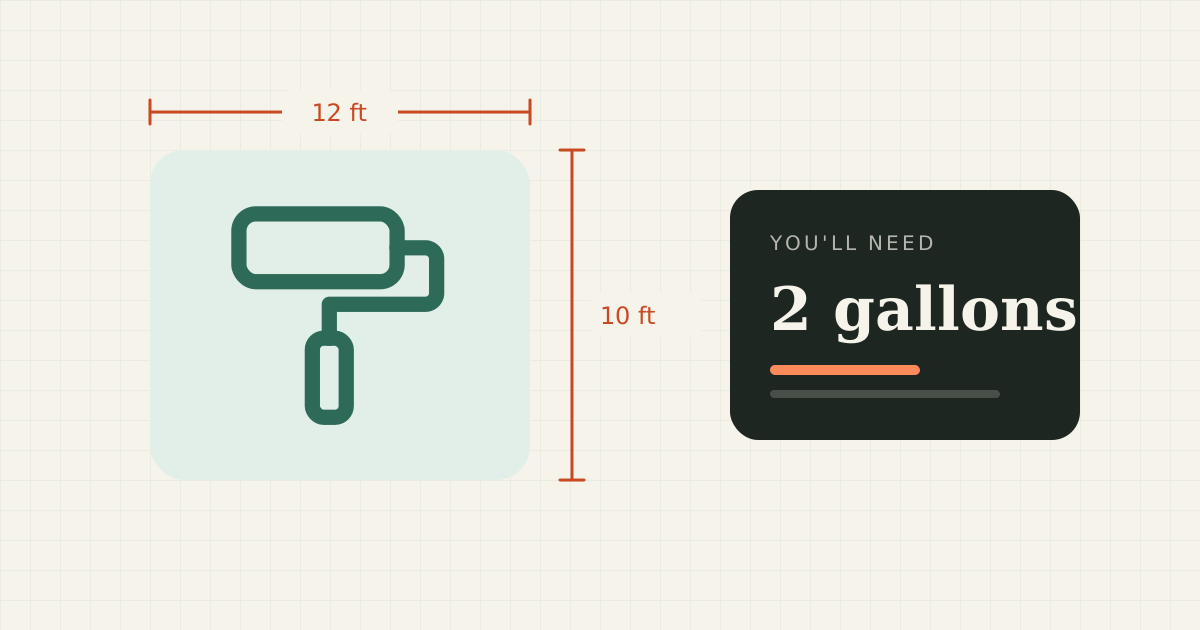
Worked example: a 12 × 10 bedroom
- Perimeter: 12 + 10 + 12 + 10 = 44 ft
- Wall area: 44 × 8 ft = 352 sq ft
- Minus one door (21) and two windows (30) = 301 sq ft
- Two coats: 602 sq ft
- 602 ÷ 350 = 1.72 gallons
On paper that's one gallon and three quarts. In most stores a second gallon costs less than three quarts, so the calculator tells you to buy 2 gallons.
When to plan for more paint
- Textured walls. Knockdown, orange peel and old plaster soak up more paint. Drop the coverage to 300.
- Brick, block or stucco. Use 200 to 250. Rough surfaces hide a lot of extra area.
- Bare drywall or fresh patches. Prime first. Unprimed joint compound shows through the finish coat, and you end up painting a third time.
- Big color changes. Navy to white, or white to a deep red, often takes three coats even with a paint-and-primer product.
Small habits that save a second trip
If you need more than one gallon of the same color, pour them together into a bucket and stir before you start. Painters call this boxing, and it hides the tiny shade differences between cans.
Save a little for touch-ups and write the color name and code on the lid. Some people stick a label inside the light switch plate too. Two years from now you'll be glad you did.
Trim and doors usually get a different sheen. Measure them on their own, or use the baseboard and trim calculator to get the footage. Not sure which finish to pick? Our paint sheen guide walks through each one.
Frequently asked questions
How many square feet does a gallon of paint cover?
Most interior latex paint covers 350 to 400 square feet per gallon on smooth, primed walls. Textured walls, bare drywall and dark colors bring that down, so plan on 300 or less for those.
Do I really need two coats of paint?
In most cases, yes. One coat can look fine while it's wet, but it usually dries patchy near edges and roller lap marks. Two coats give an even color and a finish that stands up to cleaning.
How much paint do I need for a ceiling?
Multiply the room length by the width. A 12 by 12 ceiling is 144 square feet, which is under half a gallon per coat. Flat ceiling paint is the usual pick because it hides small flaws.
Should I subtract doors and windows?
For a normal room it changes the total by about a quart, which is why the calculator does it. If the room has very few openings, set them to zero and keep the extra for touch-ups.
Results are estimates for planning. Product coverage, site conditions and installation methods vary, so check manufacturer guidance before you buy.